Accession 004: Big Iron

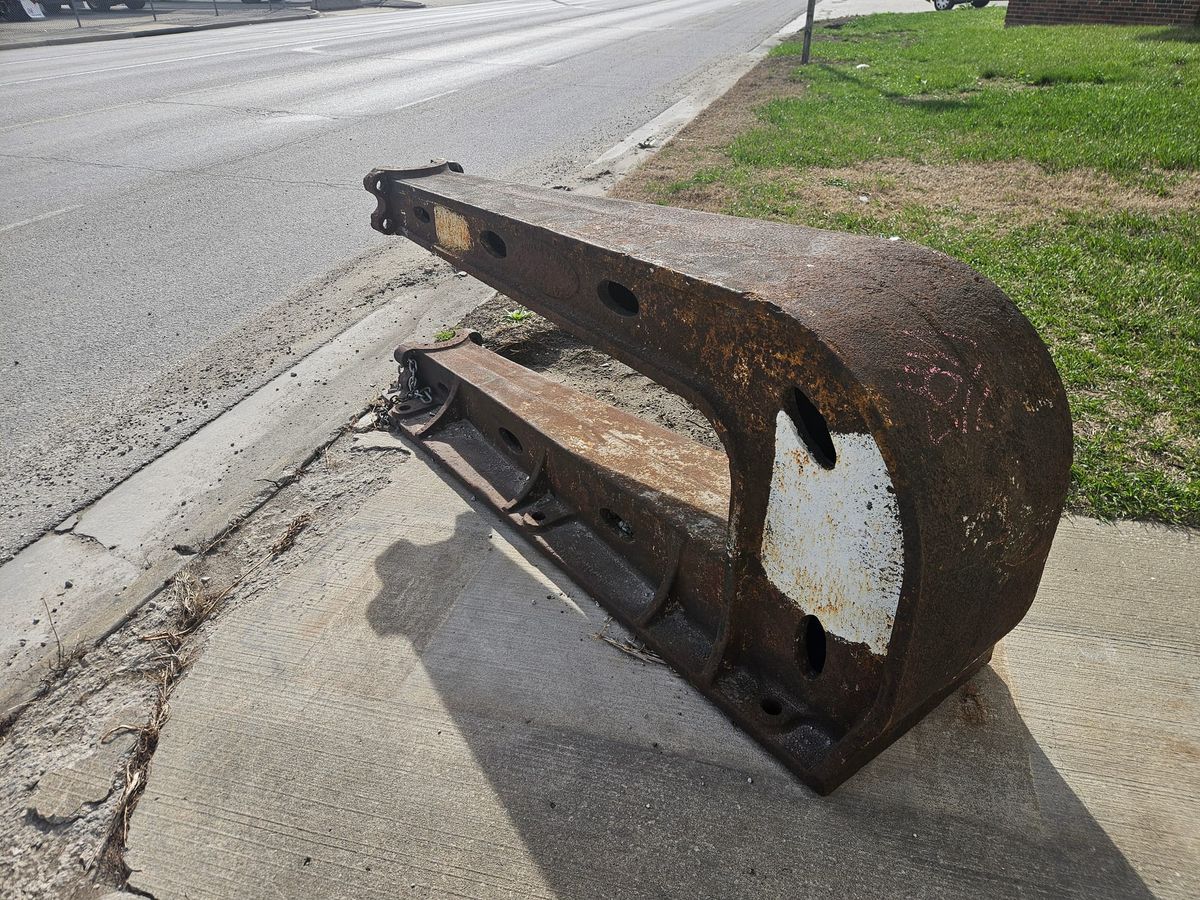
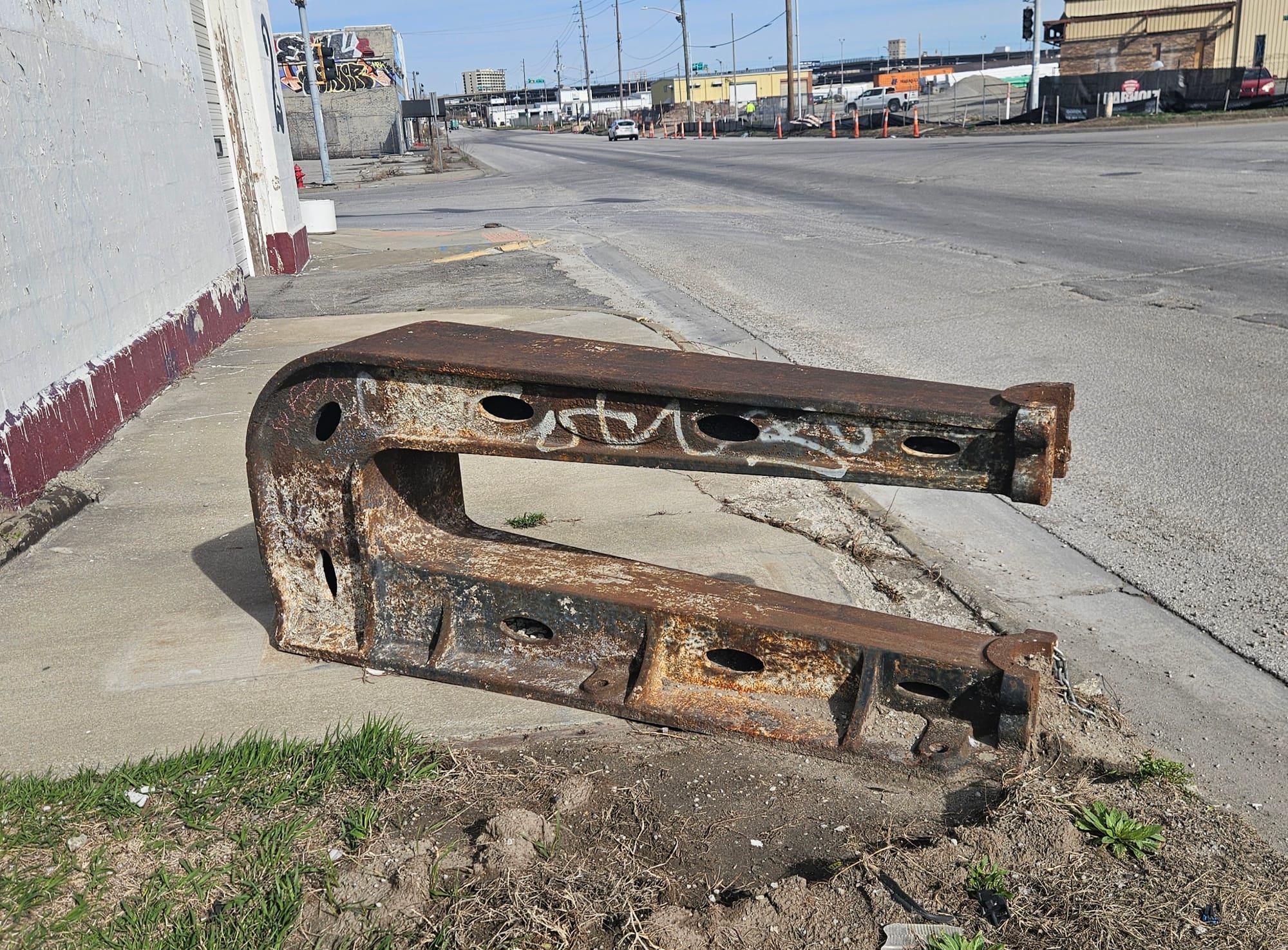
At the intersection of James St and Central Ave is a building with a stone engraving reading “Kansas City Railways Company”. On the sidewalk in front of the building rests this massive cast iron object.
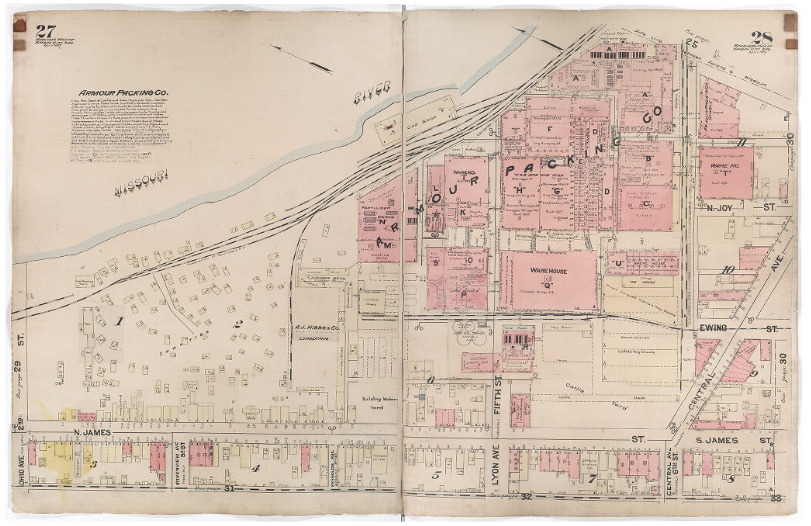
This intersection is on the Kansas side of the state line, but is still part of the West Bottoms, the district surrounded by the Missouri and Kansas River. According to insurance maps published by the Rascher Insurance Map Publishing company, the area was home to the Armour Packing Company, with the immediate surroundings mostly being a mix of cattle pens, warehouses, smoking facilities, and related meat-packing operations. These were well-established prior to the publication of the maps between 1889 and 1891. The entire complex is directly to the west of the area discussed in the accession for The Wettest Block in the World.
The building itself is a taciturn cube of red brick with a single garage door on the street, and a door on the corner under a small awning. The first story is windowless and painted white. The second story features windows all around, but no obvious signs of recent occupancy, save for the small logo on the door advertising a cafe (seemingly) affiliated with the motorcycle garage next door. While one may presume that the “Kansas City Railways Company” sign would give some indication as to the historical function of the building, little around suggests anything directly related to that purpose. From cursory research, the KCRC was a spin-off of the original Kansas City Streetcar Authority. In the early 20th century, Kansas City had a large and heavily trafficked streetcar service, like most major metropolitan areas. The KCRC was active from 1911 to 1925, which would have placed it here during the peak of the success of the stockyards, and the West Bottoms overall as a nexus of industrial logistics. From Wyandotte county tax records, all I have been able to determine of its subsequent history is its current ownership by a local family trust. Presumably, the KCRC faded as buses supplanted streetcars as the preferred mode of public transportation, alongside the rise of the automobile as a consumer good.
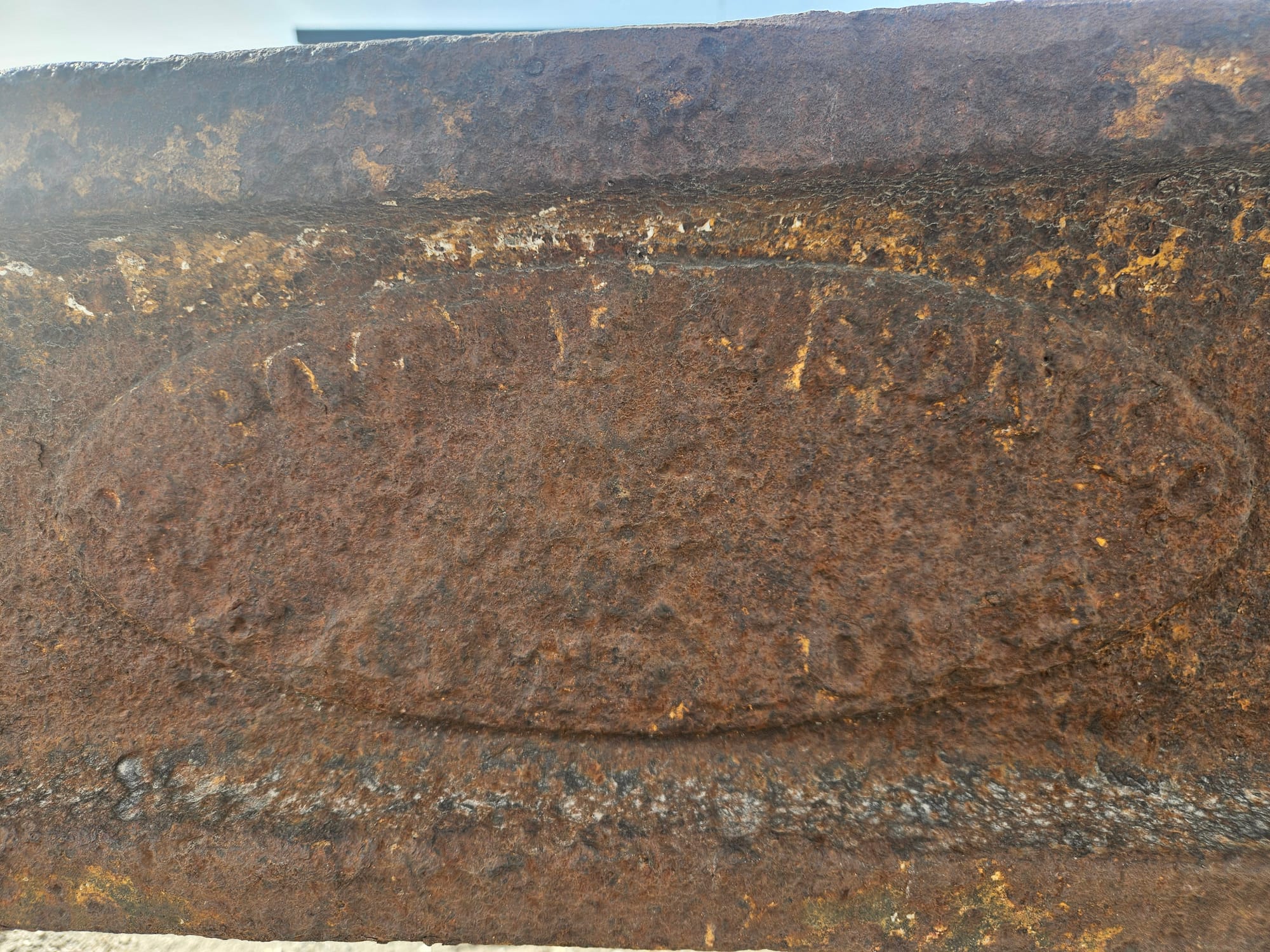
The object on the sidewalk does not explain itself. It has a logo embossed along the top arm, but it is rusted to the point of near total obscurity. My best attempt to decipher it suggests that it reads “Boone and Son Co.” along the top, which may have been an iron foundry, but I do not have any reliable sources to corroborate this already tenuous interpretation. There is no other signage or infrastructure that appears related to it nearby.
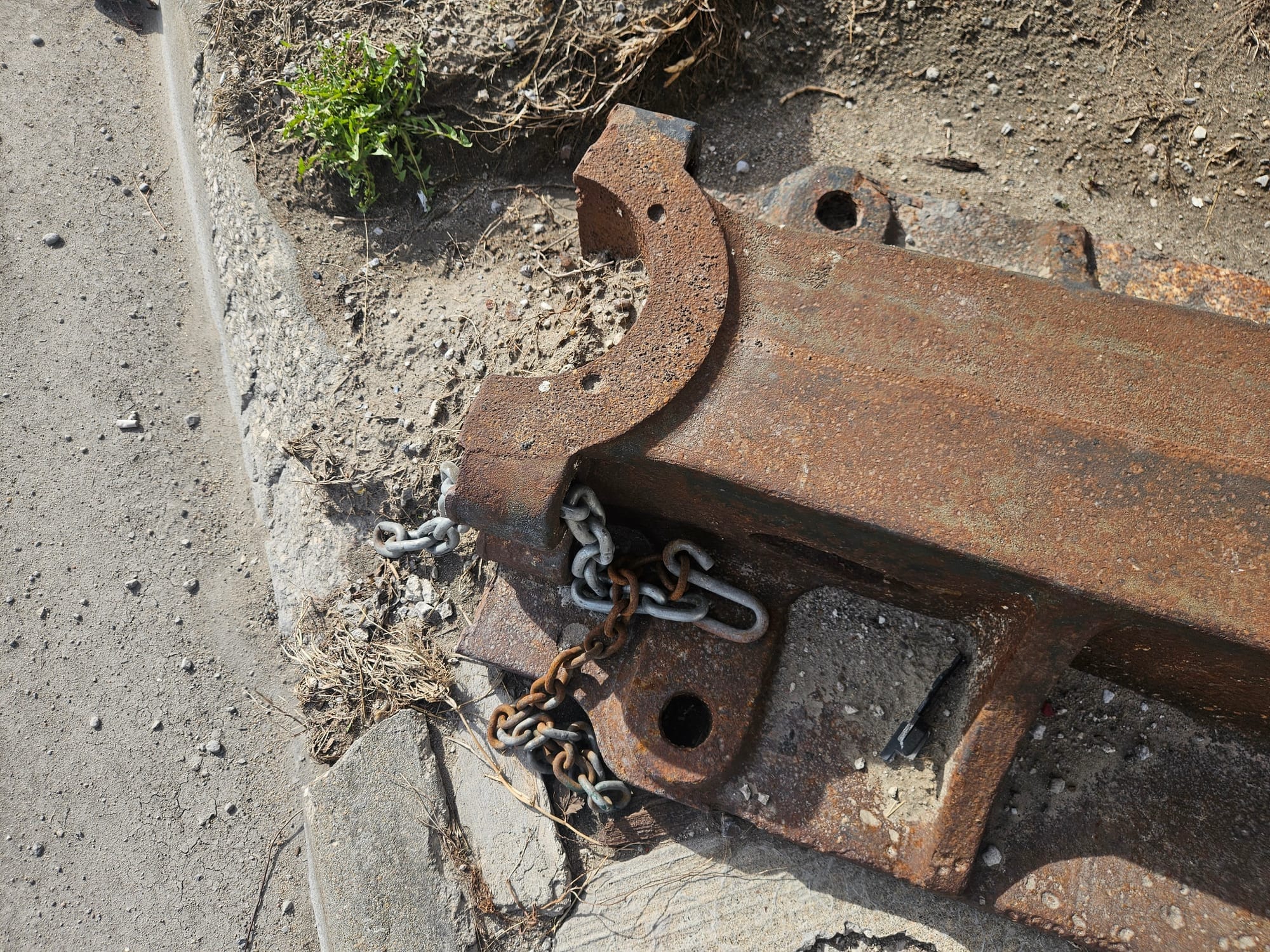
The thing itself is perhaps 4 ft. high, and approximately 8 ft. long. With some back-of-the-napkin math, it most likely weighs between 2 to 4 tons if it is truly solid cast iron. The holes throughout imply that it was affixed to something else in its history, and that it had cables or chains running through it. It terminates in a rounded coupling, with flanges that look like they could have had matching counterparts on the other side of whatever cylinder formed the axis between them.
Nothing about the area’s history points to a particular point of origin. It could be part of the railyards that transported livestock and packed meat. Perhaps it’s the hinge of a massive gate assembly within the stockyards or processing houses. Its presence outdoors, unattached, on a public sidewalk suggests only that it was left here because moving it would be more expensive than choosing to abandon it. In some sense, it is litter that is simply too heavy to dispose of.
The ‘foundness’ of both the building and the object is my shared source of interest. German philosopher Martin Heidegger articulated the idea of geworfenheit, or ‘thrownness’, meant to characterize the nature of our embodiment in time. Through the lens of geworfenheit, we simply are in a place and time with no external justification or explanation; we do not choose when and where we are born, the language we speak, or the circumstances around us, but we are simply thrown into being. Life is the act of reckoning with that situation, finding and building our relationships to the world made up of similarly ‘thrown’ people and objects. We (in the sense of the building, the cast iron, and you and I as observers) are separated by time. The gap between the useful life of the iron and my observation of it, between me writing this article and you reading it, is irreconcilable in the sense that we cannot inhabit other moments of time. But we have the opportunity to share that geworfenheit through simple presence and choice. As a Necropolitan, my interest is in seeing something unexplained or abandoned as a fellow traveler of being and time. Today, the iron is something between found art and the skeletal remnants of a whalefall. The embossed stamp that used to bridge its silence and its meaning has faded. Its carefully engineered form is mute to its intended application. Its location on the street sits in defiance of clear public traffic and the logistics of displacement. While I cannot know what it is or why it is there, I can offer it the consolation of being seen and acknowledged, and welcomed as part of the historical landscape.
Sources Cited:
KC History, Missouri Valley Special Collections. "Rascher's Map of Kansas City, Kansas, Plates 027 & 028" Accessed March 16, 2026
https://kchistory.org/image/raschers-map-kansas-city-kansas-plates-027-028?search=rascher
Wyandotte Public Access. https://appr.wycokck.org Accessed March 10, 2026Wikipedia. "Kansas City Public Service Company". Accessed March 11, 2026
https://en.wikipedia.org/wiki/Kansas_City_Public_Service_Company